Goldmund Sees the Wooden Madonna and Goes to Niklaus
Narcissus and GoldmundGoldmund Sees the Wooden Madonna and Goes to Niklaus marks the moment when an encounter with a sculpture gives Goldmund’s wandering a direction. Moved by a wooden Madonna in a cloister church, he seeks out her maker, Master Niklaus, and asks to become his apprentice. The meeting joins an inward recognition to the material tests of artistic work: a drawing of Narcissus earns Goldmund the chance to learn, though not through the guild’s conventional apprenticeship.
The Madonna and a New Direction
After confessing his past in a cloister, Goldmund is about to leave the church when sunlight falls through a window and draws his attention to a side chapel. There he sees a wooden Madonna, gently leaning forward beneath a blue cloak, with a delicate hand extended. The statue’s lively expression and graceful posture move him deeply. He returns to look at it even after turning away, as if it answers an image he has encountered in dreams and longings.
The priest, Father Bonifazius, explains that the sculpture has been in the cloister for only a year, given by a benefactor. Its maker is Master Niklaus, a carver in the bishop’s city. The work is controversial: some consider it too modern and worldly to represent the mother of God, while others value it. Goldmund responds not to that dispute but to the Madonna’s beauty, and asks eagerly to hear about the artist. Father Bonifazius knows little about Niklaus, but describes him as gifted and high-minded, and encourages Goldmund to visit him.
The statue’s particular achievement lies in the life Goldmund perceives in its face: sorrow and sweetness coexist, and religious subject and human presence are not easily separated. His attraction is therefore more than admiration for a devotional object. The Madonna makes visible a kind of beauty he has sought, and the encounter gives that search a concrete destination.
Seeking the Master
Goldmund leaves the church changed. The road, previously a place of freedom and wandering, becomes a route to Niklaus and to a possible vocation. He hurries to the city, paying little attention to its traffic and bustle, and asks strangers for the master’s address. After finding it, he returns the next morning from the cloister where he has spent the night and is eventually led into Niklaus’s workshop.
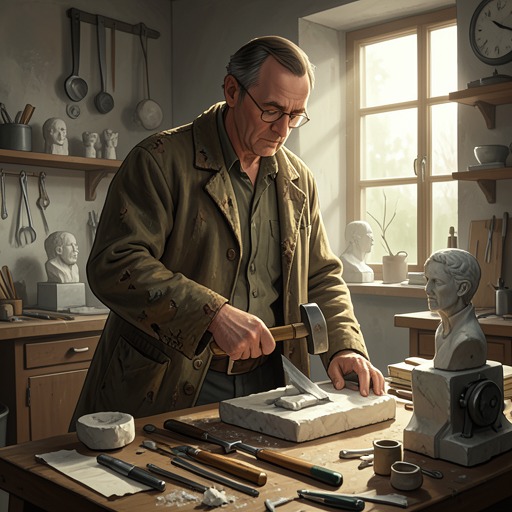
Niklaus is a tall, bearded craftsman with a leather apron and a curt manner. Goldmund delivers Father Bonifazius’s greetings, then explains that the Madonna has brought him to the workshop. He asks to become Niklaus’s apprentice. He presents himself as a wanderer with no home or parents, formerly a student who learned Latin and Greek before leaving the cloister and taking to the roads. His request is urgent, but Niklaus makes clear that admiration and conversation are not a qualification for workshop labor: what matters there is what a person can make with his hands.
Rather than accept him immediately, Niklaus sets him a test. He gives Goldmund paper and charcoal and tells him to draw, allowing him until noon or evening. Goldmund first watches the master working on a small clay figure. Then, absorbed in his task, he draws the image of his friend Narcissus as he carries it within him. The drawing becomes a personal act of remembrance as well as an artistic trial: Goldmund works with reverence, without attending to the passing time or the movement of light in the workshop.
An Unusual Apprenticeship
When Niklaus examines the large sheet, he asks who the drawn man is. Goldmund answers that it is his friend, a young monk and scholar. The work has faults, but Niklaus recognizes its beauty and takes the request seriously. The decision is not automatic: Goldmund is older than a normal apprentice, and the established path requires years of service and payment by the apprentice’s father. Under guild custom, apprentices usually begin at thirteen or fourteen, and spend much of their training running errands. Goldmund is already a grown man, without a father to pay, and does not seem suited to being ordered about.
Niklaus nevertheless offers him a trial outside those rules. There will be no contract or obligation, and Goldmund may leave whenever he chooses. He can learn in the workshop and attempt carving, though he may ruin tools or woodblocks; if he proves unsuited to wood carving, he will have to try something else. The offer is a recognition of individual promise, not guild advancement. Niklaus sees that the drawing’s beauty warrants a chance, even though Goldmund cannot enter the profession by its usual route.
This arrangement establishes the central tension of Goldmund’s training. Workshop practice requires materials, patience, and sustained effort; Goldmund’s independence and unsettled habits resist the discipline on which a stable craft career depends. Yet the relationship begins with a concrete judgment of his work, rather than with his eloquence or his account of himself.
The Work That Follows
During the year after his arrival, Goldmund becomes an able draftsman and sometimes models in clay. His first successful sculpture is a figure of Julie, Lydia’s younger sister, a little over two spans high. Niklaus praises it but refuses Goldmund’s wish to have it cast in metal, judging it too worldly for him to sponsor. The episode shows the difference between Goldmund’s appetite for forms of beauty and the master’s authority over which works he will undertake or endorse.
Goldmund’s next major undertaking is a wooden statue of Narcissus as the Apostle John, intended for a commissioned crucifixion group. Unlike the clay figure, this work draws him into sustained concentration. His love for Narcissus guides the image, and the carving helps him recover his own artistic purpose whenever he loses his way. Affairs, drinking, gambling, and fights can take him away from the workshop, but when he returns to the statue he works with devotion. In the figure’s features, he seeks to preserve the character of his absent friend in a form that can outlast the instability of ordinary life.
Goldmund’s wider artistic ambition also grows from the Madonna encounter. He hopes one day to give visible form to the maternal image that has changed within him: an image rooted in the memory of his own mother and reshaped by his experience of women. It is not meant to portray one particular person, but a source of life associated in his imagination with ecstasy, pain, and death. His later response to a painted Dance of Death clarifies the contrast. The fresco presents death as an inescapable end, carrying figures from king and bishop to peasant and soldier; Goldmund experiences death as also intimate and maternal. After seeing the image, he feels renewed attraction to the master and his craft, even as the road continues to delay him with suffering and encounters that demand his attention.
Art, Discipline, and Departure
Niklaus’s appreciation of Goldmund’s work eventually leads him to seek a more permanent arrangement. He obtains a master’s diploma for Goldmund and proposes that they become associates, share important commissions and earnings, and preserve the standing of the workshop. Niklaus is aging, wants to protect the quality of his enterprise, and believes Goldmund’s statue of Saint John surpasses what his assistants could make. His offer would give Goldmund professional security and a place in the workshop, but it also asks him to settle.
Goldmund does not accept that future. His pride in the homeless life and his disdain for settled ownership bring him close to leaving more than once. Niklaus’s patience rests in large part on the work itself: despite his frustrations with Goldmund’s conduct, he watches the Saint John take shape and believes it will be completed. When the statue is finished, Goldmund experiences the end of the work as the end of the meaning that had held his life in the city together. The master’s proposed partnership cannot overcome his restlessness, and Goldmund leaves.
The episode therefore does not end with artistic vocation replacing wandering. Instead, the Madonna gives Goldmund a destination and the workshop gives his gift a form, while neither removes the conflict between making art and accepting a settled life. The statue that first summoned him and the drawing that won him a place with Niklaus open a lasting relation between vision and craft; his later departure shows that recognition and talent do not, by themselves, make him willing to remain.